Current research does not show that IV therapy treats stress or burnout. A small number of studies suggest that certain IV nutrients, most notably high-dose vitamin C, may modestly and temporarily reduce fatigue in healthy adults, but fatigue, stress, and burnout are distinct experiences, and evidence for one should not be assumed to apply to the others. IV therapy may have a legitimate role in specific situations, such as documented dehydration or a diagnosed nutrient deficiency. Still, it is not a substitute for evidence-based stress management or mental health treatment.
This article walks through what the research actually shows, how stress, burnout, and fatigue differ, when IV nutrient therapy may be medically appropriate, and what else is worth considering if you are dealing with chronic stress or burnout.
What Is IV Therapy?
IV (intravenous) therapy delivers fluids, vitamins, minerals, or medications directly into the bloodstream through a vein, bypassing the digestive system. In a clinical setting, IV fluids are used for established medical purposes such as treating dehydration, correcting a diagnosed electrolyte imbalance, or administering medications that require rapid action.
Outside the hospital, IV nutrient infusions, sometimes called vitamin drips or wellness IVs, are also marketed directly to consumers for energy, hydration, immune support, and general wellness.
These are related but different uses of the same basic technology. A saline drip given to a dehydrated patient in a clinical setting and a vitamin blend marketed for an energy boost are not interchangeable just because both involve an IV line.
Why Is IV Therapy Marketed for Stress, Fatigue, and Burnout?
IV nutrient therapy is often marketed for stress and burnout because these are common, high-demand concerns, and the format of an IV, fast delivery directly into the bloodstream, appeals to people looking for quick relief. B-complex vitamins, vitamin C, magnesium, and other ingredients used in these infusions do play real roles in energy metabolism and the body’s stress response, which is part of why the marketing feels plausible.
However, playing a biological role in stress physiology is not the same as having clinical evidence that infusing these nutrients into a healthy adult meaningfully treats stress or burnout. Much of the marketing around IV therapy for stress relies on this kind of plausibility rather than on trials that directly measured stress or burnout outcomes.
What Does the Research Say About IV Therapy for Stress?
The most relevant published evidence comes from a randomized, double-blind, placebo-controlled trial of 141 healthy office workers who received either 10 grams of intravenous vitamin C or a saline placebo. The vitamin C group reported significantly lower fatigue scores at two hours and one day after the infusion, along with reduced markers of oxidative stress, compared with the placebo group.
This is a genuine, well-designed study, but it has meaningful limits worth understanding:
- It measured self-reported fatigue, not clinically diagnosed stress or occupational burnout
- The effect was measured at two hours and one day, not over weeks or months
- Participants were healthy office workers, not people with a diagnosed burnout syndrome or a clinical mental health condition
- A single infusion of vitamin C is a different intervention than a recurring “wellness IV” marketed as a stress or burnout treatment
Separately, some research has examined oral magnesium combined with vitamin B6 for perceived stress in adults with low magnesium levels, using a validated stress scale.
This research points to a possible role for correcting an underlying magnesium deficiency in people who have one, but it used oral supplementation, not IV infusion, and it was conducted in a specific population with low baseline magnesium rather than the general public. It should not be read as evidence that IV vitamin infusions treat stress in people without a documented deficiency.
Taken together, current evidence does not establish that IV nutrient therapy treats stress. Some findings suggest a possible short-term effect on fatigue in specific circumstances, and more research, particularly research that measures stress and burnout directly rather than fatigue alone, is needed before broader claims are justified.
Can IV Therapy Help With Burnout?
There is currently no clinical trial evidence directly testing IV nutrient therapy against occupational burnout as defined by the World Health Organization. The World Health Organization’s ICD-11 describes burnout as a syndrome resulting from chronic workplace stress that has not been successfully managed, characterized by three dimensions: feelings of energy depletion or exhaustion, increased mental distance or cynicism related to one’s job, and reduced professional efficacy. Burnout is classified as an occupational phenomenon, not a medical diagnosis, and it is specifically tied to the work context rather than life in general.
Because burnout involves emotional, cognitive, and workplace-related dimensions beyond physical energy, it is not something that would be expected to resolve with a nutrient infusion alone, even if that infusion has a temporary effect on physical fatigue.
No published research to date supports IV therapy as a treatment for burnout specifically, and claims to that effect should be treated as unproven marketing rather than established evidence.
Does IV Therapy Help With Fatigue or Low Energy?
The evidence here is more specific than for stress or burnout, but still limited and situation-dependent.
| Question | What the Evidence Suggests |
|---|---|
| Can IV therapy correct dehydration? | Yes, IV fluids are an established, effective treatment for clinically significant dehydration when administered appropriately |
| Can IV therapy correct a diagnosed nutrient deficiency? | Yes, when a deficiency has been diagnosed through testing, IV or oral repletion can be medically appropriate depending on the nutrient and severity |
| Does IV therapy improve general fatigue in healthy adults? | Some evidence, such as the vitamin C trial in office workers, suggests a modest, short-term effect; this is not the same as a durable energy or wellness benefit |
| Does IV therapy treat burnout? | No direct evidence; burnout involves occupational and psychological dimensions that a nutrient infusion does not address |
| Can IV therapy replace mental health treatment? | No; persistent stress, burnout, anxiety, or depression are appropriately addressed through evidence-based approaches such as therapy, and IV therapy should not be presented as a substitute |
What Is the Difference Between Stress, Burnout, and Fatigue?
These terms are often used interchangeably in marketing, but they describe different things:
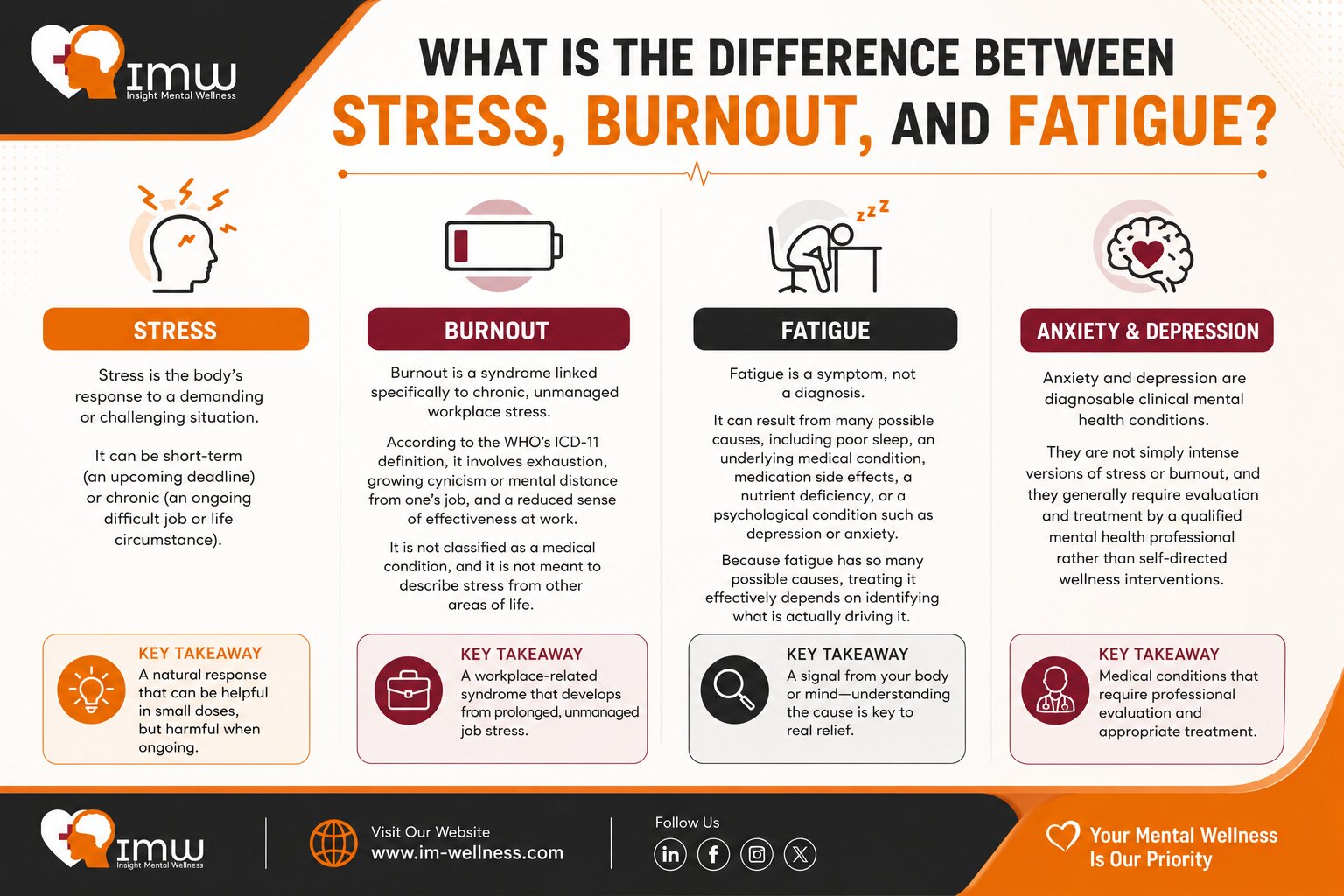
Stress is the body’s response to a demanding or challenging situation. It can be short-term (an upcoming deadline) or chronic (an ongoing difficult job or life circumstance).
Burnout is a syndrome linked specifically to chronic, unmanaged workplace stress. According to the WHO’s ICD-11 definition, it involves exhaustion, growing cynicism or mental distance from one’s job, and a reduced sense of effectiveness at work. It is not classified as a medical condition, and it is not meant to describe stress from other areas of life.
Fatigue is a symptom, not a diagnosis. It can result from many possible causes, including poor sleep, an underlying medical condition, medication side effects, a nutrient deficiency, or a psychological condition such as depression or anxiety. Because fatigue has so many possible causes, treating it effectively depends on identifying what is actually driving it.
Anxiety and depression are diagnosable clinical mental health conditions. They are not simply intense versions of stress or burnout, and they generally require evaluation and treatment by a qualified mental health professional rather than self-directed wellness interventions.
Conflating these terms is part of why IV therapy marketing for stress and burnout can be misleading. Evidence about fatigue in healthy office workers does not automatically extend to burnout, and neither condition is the same as a diagnosable mental health condition.
When Can IV Nutrient Therapy Be Medically Appropriate?
IV nutrient therapy has a more defensible role in specific circumstances, including:
- Clinically significant dehydration that needs rapid correction
- A diagnosed vitamin or mineral deficiency, confirmed through lab testing, where a clinician determines IV administration is appropriate
- Situations where oral intake or absorption is impaired for a medical reason
- Specific clinical protocols directed by a healthcare provider for a diagnosed condition
In these situations, IV therapy is used to correct a defined physiological problem, not to treat stress, burnout, or general low mood. A useful question to ask before pursuing IV therapy for stress or fatigue is whether there is an actual diagnosed reason for it, or whether it is being used as a general wellness measure without a specific medical indication.
What Are the Potential Benefits of IV Therapy?
When appropriately indicated, potential benefits can include:
- Rapid rehydration in cases of significant fluid loss
- Fast correction of a documented nutrient deficiency
- Direct bloodstream delivery of nutrients when oral absorption is limited
- A possible short-term reduction in fatigue symptoms, based on limited evidence such as the office worker vitamin C trial
These benefits are tied to specific situations and should not be generalized into a broad claim that IV therapy improves stress, burnout, mood, or overall wellness for everyone who receives it.
What Are the Risks and Side Effects of IV Therapy?
Risk depends on the specific infusion, its ingredients, the dose, the clinical setting, and the individual patient’s health. Potential risks and side effects associated with IV therapy can include:
- Bruising, discomfort, or irritation at the IV site
- Infection at the insertion site if sterile technique is not properly followed
- Phlebitis (inflammation of the vein)
- Allergic or hypersensitivity reactions to specific ingredients
- Electrolyte imbalances, particularly with certain formulations or in people with underlying kidney or cardiac conditions
- Complications related to excessive or inappropriate dosing of specific vitamins or minerals
This is not an exhaustive or universally applicable list. Risk varies significantly based on what is actually being infused and the health status of the person receiving it, which is why IV therapy should involve a review of health history before treatment.
Who Should Be Cautious About IV Therapy?
People with certain health conditions may need to be more cautious about IV nutrient therapy, or should discuss it with a healthcare provider first, including those with:
- Kidney disease, which can affect how the body handles fluids and electrolytes
- Heart conditions, particularly those affecting fluid balance
- A known allergy or sensitivity to a specific ingredient in the infusion
- Certain conditions where rapid fluid or nutrient shifts could be harmful
Anyone considering IV therapy, especially for a non-emergency, wellness-oriented reason, should have their health history reviewed by a qualified provider before treatment.
What Other Approaches Can Help With Stress and Burnout?
Because burnout and chronic stress are multi-dimensional, evidence-based approaches tend to address more than physical energy alone.
| Approach | Evidence | Time Commitment |
|---|---|---|
| Sleep improvement | Strong evidence linking sleep quality to stress resilience and mood | Ongoing, daily habit |
| Physical activity | Well-established evidence for stress and mood benefits | Ongoing, regular practice |
| Psychotherapy | Strong evidence base for treating chronic stress, burnout-related distress, anxiety, and depression | Typically weekly sessions |
| Stress-management strategies | Evidence supports structured approaches such as cognitive-behavioral techniques | Varies |
| Medical evaluation | Important when fatigue, stress, or low mood is persistent, to rule out an underlying condition | One-time evaluation, possible follow-up |
| Nutritional assessment | Appropriate when a deficiency is suspected, based on symptoms or risk factors | One-time testing, possible ongoing monitoring |
No single approach is universally superior. For many people, addressing chronic stress or burnout involves a combination of these strategies rather than any single intervention, including IV therapy.
If ongoing stress, workplace burnout, or related symptoms such as anxiety or low mood are affecting daily functioning, individual therapy that specifically addresses stress management, along with underlying anxiety or depression, is an evidence-based starting point. Insight Mental Wellness’s therapy services include individual sessions focused on stress management, emotional regulation, and coping strategies, which directly target the psychological and occupational dimensions that a nutrient infusion does not address.
Is IV Therapy Right for You?
IV therapy may be worth considering if you have a specific, identifiable reason for it, such as documented dehydration or a diagnosed nutrient deficiency. It is less clearly supported as a stand-alone approach to ongoing stress or burnout, where the underlying drivers are typically psychological, occupational, or lifestyle-related rather than a simple nutrient shortfall.
If you are interested in trying IV therapy as part of a broader wellness routine, it can be reasonable to do so with realistic expectations. If our IV Therapy 101 guide covers what to expect before a first visit, and our breakdown of what’s actually in an IV drip explains the common ingredients used in these formulations and what each is generally understood to do. If persistent stress, burnout, or low energy is significantly affecting your work or daily life, that is a signal worth discussing with a healthcare provider or therapist rather than addressing through wellness IVs alone.
IV Therapy for Stress and Burnout in Dallas, TX
Patients in the Dallas area researching IV therapy for stress, fatigue, or general wellness have access to IV nutrient infusions through Insight Mental Wellness’s IV Therapy service, which offers a range of formulations focused on hydration, energy, and immune support. Because Insight Mental Wellness is a mental health practice first, patients considering IV therapy for stress or burnout-related symptoms also have direct access to therapy and medication management services under the same practice, which allows for a more complete conversation about what is actually driving those symptoms rather than treating fatigue in isolation.
Key Takeaways
- Current evidence does not establish that IV therapy treats stress or burnout; the most relevant study measured short-term fatigue in healthy office workers, not stress or burnout specifically.
- Stress, burnout, and fatigue are distinct: burnout is specifically tied to chronic, unmanaged workplace stress, while fatigue is a symptom with many possible causes.
- IV therapy has a clearer role when there is a specific medical reason, such as documented dehydration or a diagnosed nutrient deficiency.
- Risks depend on the specific infusion and individual health history, and anyone considering IV therapy should have that history reviewed beforehand.
- IV therapy should not be presented as, or relied on as, a substitute for evidence-based mental health treatment such as therapy.
- If stress or burnout is persistent or affecting daily functioning, evaluation by a healthcare provider or therapist is a more evidence-based next step than a wellness infusion alone.
Frequently Asked Questions
Can IV therapy help with stress? There is limited evidence that specific IV nutrients, such as high-dose vitamin C, may modestly and temporarily reduce fatigue in healthy adults. This is not the same as evidence that IV therapy treats psychological stress, and no research has directly established that IV therapy reduces stress itself.
Can IV therapy treat burnout? No published research supports IV therapy as a treatment for burnout. Burnout, as defined by the World Health Organization, involves occupational and psychological dimensions, exhaustion, cynicism, and reduced effectiveness at work, that a nutrient infusion does not address.
Does IV therapy help with fatigue? Some evidence, including a randomized trial in healthy office workers, suggests a short-term reduction in fatigue scores after high-dose IV vitamin C. Effects were measured over about a day, and fatigue has many possible underlying causes that IV therapy does not address.
How long do the effects of IV therapy last? This depends heavily on the specific infusion and the reason for treatment. In the office worker vitamin C study, the fatigue-reduction effect was measured at two hours and one day after infusion. Effects for hydration or documented deficiency correction can vary based on the individual and the underlying issue being treated.
What are the risks of IV therapy? Possible risks include bruising or irritation at the IV site, infection, phlebitis, allergic reactions, and electrolyte imbalances, particularly in people with certain underlying health conditions. Risk varies by the specific infusion and the patient’s health history.
Is IV therapy safe for everyone? Not necessarily. People with kidney disease, certain heart conditions, or known sensitivities to specific ingredients may need to avoid or approach IV therapy cautiously, and a health history review before treatment is appropriate.
Can IV therapy replace therapy or mental health treatment? No. IV therapy does not address the psychological, occupational, or behavioral factors involved in chronic stress, burnout, anxiety, or depression. Evidence-based treatments such as psychotherapy remain the appropriate approach for these conditions.
What should I ask before getting IV therapy? Useful questions include: What specific ingredients are in this infusion and why? Is there a diagnosed reason for this treatment, or is it general wellness? What are the risks for someone with my health history? How is this different from addressing the underlying cause of my symptoms directly?
Is IV therapy available in Dallas? Yes. Insight Mental Wellness offers IV Therapy in Dallas, TX, alongside its mental health services.
Ready to Talk Through Your Options?
If ongoing stress, burnout, or fatigue is affecting your daily life, it is worth talking with a healthcare professional about what is actually driving those symptoms before assuming a wellness IV is the answer. Insight Mental Wellness offers both IV Therapy and evidence-based therapy services in Dallas, TX, so you can have a complete conversation about what approach, or combination of approaches, actually fits your situation. Contact us to learn more or schedule a consultation.