Relationships rarely fall apart overnight. More often, it’s a slow buildup of unspoken resentment, repeated arguments, emotional distance, or a single event that shakes the foundation. Couples therapy exists for exactly these moments, not just to “fix” what’s broken, but to help two people understand each other again.
If you’ve been searching for clarity on what couples therapy actually involves, whether it works, and if it’s right for your relationship, this guide walks you through everything you need to know based on established clinical practice and what real couples experience in the therapy room.
What Is Couples Therapy?
Couples therapy (sometimes called couples counseling, marriage counseling, or relationship therapy) is a form of psychotherapy where a licensed mental health professional helps two people in a romantic relationship work through conflict, improve communication, rebuild trust, or navigate major life transitions.
It’s not just for marriages on the brink of divorce. Dating partners, engaged couples, long-term unmarried partners, and same-sex couples all benefit from it. The goal isn’t to assign blame, it’s to help both partners understand the patterns shaping their relationship and decide, together, what to do next.
A trained couples therapist acts as a neutral guide. They don’t pick sides. Instead, they help each partner feel heard, identify unhealthy dynamics, and teach evidence-based tools for moving forward.
Why Couples Seek Therapy
People come to couples therapy for a wide range of reasons. Some are in crisis. Others want to strengthen something that’s already working. Common reasons include:
- Frequent arguments or unresolved conflict
- Communication breakdowns and feeling unheard
- Infidelity or breaches of trust
- Emotional or physical intimacy issues
- Parenting disagreements
- Financial stress or differing money values
- Major life transitions (marriage, new baby, relocation, retirement)
- Mental health challenges affecting the relationship
- Considering separation or divorce
- Premarital preparation
There’s no “right time” to start. In fact, research suggests couples wait an average of six years after problems begin before seeking help and earlier intervention typically leads to better outcomes.
Read More: Does Couples Therapy Work?
How Couples Therapy Works
While every therapist has their own style, most couples therapy follows a recognizable structure.
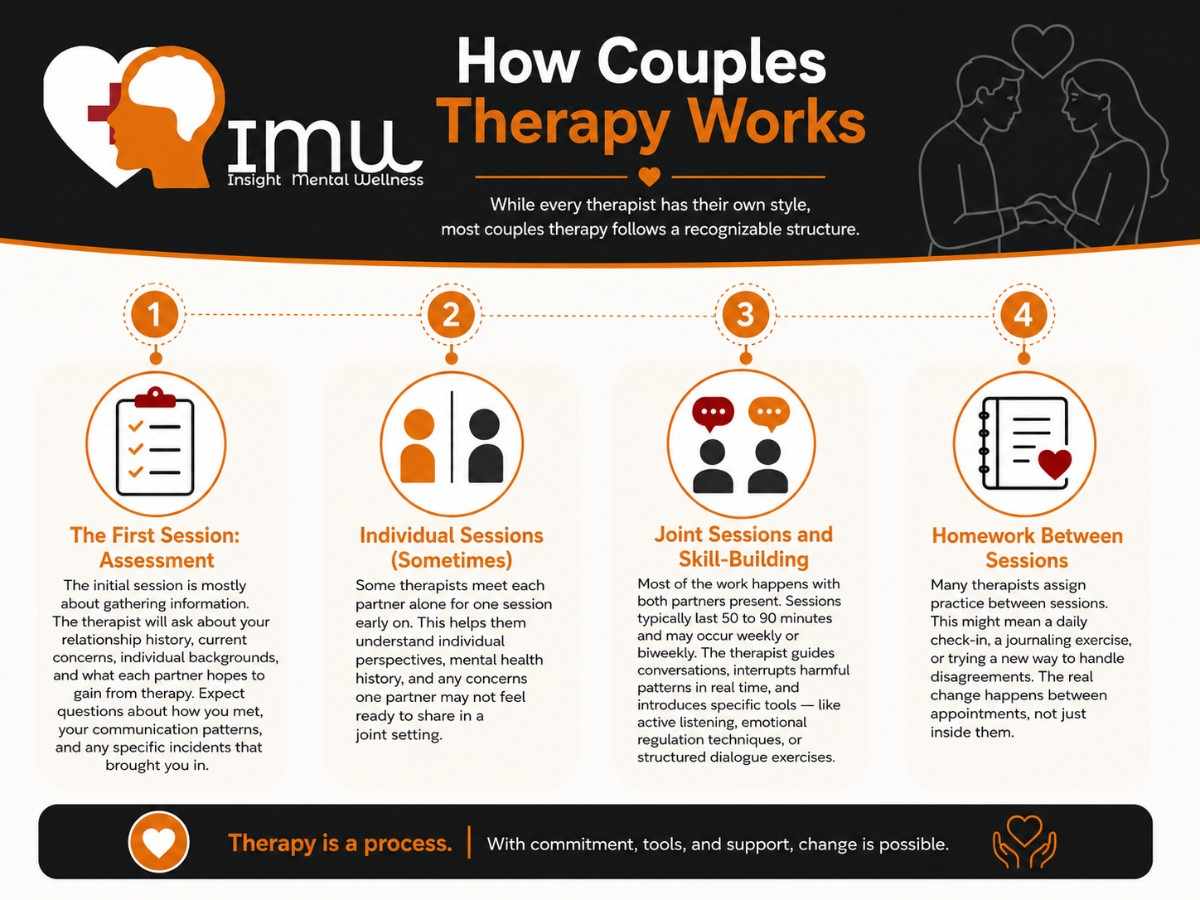
The First Session: Assessment
The initial session is mostly about gathering information. The therapist will ask about your relationship history, current concerns, individual backgrounds, and what each partner hopes to gain from therapy. Expect questions about how you met, your communication patterns, and any specific incidents that brought you in.
Individual Sessions (Sometimes)
Some therapists meet each partner alone for one session early on. This helps them understand individual perspectives, mental health history, and any concerns one partner may not feel ready to share in a joint setting.
Joint Sessions and Skill-Building
Most of the work happens with both partners present. Sessions typically last 50 to 90 minutes and may occur weekly or biweekly. The therapist guides conversations, interrupts harmful patterns in real time, and introduces specific tools — like active listening, emotional regulation techniques, or structured dialogue exercises.
Homework Between Sessions
Many therapists assign practice between sessions. This might mean a daily check-in, a journaling exercise, or trying a new way to handle disagreements. The real change happens between appointments, not just inside them.
Common Approaches Used in Couples Therapy
Different therapists use different frameworks. Knowing the main ones can help you choose someone whose method fits your situation.
| Approach | Best For | How It Works |
|---|---|---|
| Emotionally Focused Therapy (EFT) | Rebuilding emotional connection, attachment wounds | Identifies negative cycles and helps partners express deeper emotions safely |
| Gottman Method | Communication issues, conflict management | Uses research-based tools to manage conflict and build friendship/intimacy |
| Cognitive Behavioral Couples Therapy (CBCT) | Negative thought patterns, behavioral conflicts | Reframes distorted thinking and replaces destructive behaviors |
| Imago Relationship Therapy | Recurring conflicts tied to childhood wounds | Explores how early experiences shape adult relationships |
| Discernment Counseling | Couples unsure whether to stay together | Short-term approach to gain clarity before committing to full therapy |
| Narrative Therapy | Couples wanting to reframe their story | Externalizes problems and helps couples rewrite their relationship narrative |
A good therapist often blends approaches based on what each couple needs.
What Happens in a Typical Session
Walking into your first session can feel intimidating. Here’s what usually unfolds:
The therapist greets you both and reviews confidentiality. You sit together, often facing the therapist. They may ask how the week went or follow up on previous discussions. As issues come up, the therapist slows the conversation down — pointing out patterns, asking each partner to reflect, and helping you communicate without escalating.
You won’t be yelled at, shamed, or told who’s “right.” A skilled therapist creates a space where even hard conversations feel manageable.
How Long Does Couples Therapy Take?
There’s no fixed timeline, but most couples see meaningful change within 8 to 20 sessions. Some factors that influence duration:
- Severity and length of the issues
- Both partners’ commitment to the process
- Whether individual mental health concerns are present
- The therapy approach being used
- How quickly are skills practiced outside of sessions
Short-term issues (like adjusting to parenthood) may resolve in a few months. Deeper wounds — affairs, long-term resentment, attachment issues — often take longer.
Does Couples Therapy Actually Work?
Yes, when both partners are willing to engage. Research on approaches like Emotionally Focused Therapy and the Gottman Method consistently shows significant improvement for roughly 70 to 75% of couples who complete treatment. EFT, in particular, has decades of clinical research supporting its effectiveness for distressed couples.
That said, therapy works best when:
- Both partners genuinely want change (even if they’re scared)
- The therapist is properly trained in couples work, not just individual therapy
- Sessions happen consistently
- Honesty is prioritized over winning arguments
- There’s no ongoing abuse, untreated severe addiction, or active deception
If one partner has already emotionally checked out or is only attending to “prove” they tried, outcomes are harder to predict.
Read More: What kind of therapy is best for couples?
When Couples Therapy May Not Be the Right Fit
Therapy isn’t always the answer — at least not couples therapy first. It may not be appropriate when:
- There’s ongoing domestic violence or coercive control
- One partner is actively in an undisclosed affair
- Severe untreated addiction or mental illness is dominating the relationship
- One partner refuses to participate in good faith
In these cases, individual therapy, safety planning, or specialized treatment usually needs to come first.
How to Choose the Right Couples Therapist
Finding the right therapist matters more than the approach they use. Look for someone who:
- Is licensed in your region (LMFT, LCSW, LPC, or psychologist)
- Has specific training in couples therapy (not just individual work)
- Practices a recognized evidence-based approach
- Both partners feel comfortable after the first 1–2 sessions
- Maintains a neutral stance and doesn’t take sides
It’s completely normal to try a couple of therapists before finding the right fit. The therapeutic relationship itself is one of the strongest predictors of success.
Online vs. In-Person Couples Therapy
Both formats can be effective, and the right choice depends on your circumstances.
In-person sessions offer fewer distractions, stronger nonverbal cues, and a defined “therapy space” that some couples find grounding.
Online therapy offers flexibility, access to specialists outside your area, and convenience for busy schedules or couples in different locations. Research increasingly shows online couples therapy can be just as effective as in-person therapy when delivered by a trained clinician.
How to Prepare for Your First Session
A little preparation reduces first-session anxiety:
- Talk briefly with your partner about what you each hope to gain
- Write down 2–3 specific concerns you want to address
- Be ready to share some relationship history
- Come willing to listen as much as speak
- Don’t expect resolution in session one — it’s about laying groundwork
FAQs:
Is couples therapy only for married people?
No. Couples therapy supports any committed romantic relationship dating, engaged, married, partnered, or living together. It’s also effective for same-sex couples and non-traditional relationship structures.
Can couples therapy save a relationship headed for divorce?
It can, especially when both partners are willing to engage. For couples who are truly unsure whether to stay together, discernment counseling is a short-term option that helps them gain clarity before committing to full therapy.
How much does couples therapy cost?
Costs vary by location and therapist credentials, typically ranging from $100 to $250 per session in many regions, with some sliding-scale and online options costing less. Some insurance plans cover it when a mental health diagnosis is involved.
What’s the difference between couples therapy and marriage counseling?
The terms are often used interchangeably. Traditionally, “marriage counseling” referred to shorter-term, present-focused work, while “couples therapy” tends to involve deeper exploration of patterns and emotions. Most modern therapists use the terms interchangeably.
Will the therapist tell us to break up?
A good therapist won’t tell you what to do. Their role is to help you understand your relationship clearly so you can make your own informed decision — whether that’s rebuilding, restructuring, or respectfully separating.
Do both partners have to want therapy for it to work?
Ideally, yes. If one partner is unwilling, individual therapy is a great starting point; improvements in one person often shift the relationship dynamic and may open the door for joint work later.
The Bottom Line
Couples therapy is one of the most practical investments two people can make in their relationship. It’s not a sign of failure; it’s a sign that you take your partnership seriously enough to do the work. Whether you’re navigating a crisis, recovering from a betrayal, or simply wanting to feel closer, a skilled therapist can help you build something stronger than what you had before.
The hardest step is usually the first one: making the call. If your relationship matters to you, consider reaching out to a licensed couples therapist in your area or exploring reputable online platforms. The sooner you start, the more options you have.