Psychological testing typically involves five stages: an initial consultation, one or more standardized testing sessions, scoring and interpretation, a written report, and a feedback session where the results and recommendations are explained. The full process usually spans two to four appointments over one to three weeks, depending on how many tests are administered. For patients in Dallas and Fort Worth, knowing what happens at each step ahead of time makes it easier to prepare and reduces the uncertainty that often comes with a first evaluation.
What Is Psychological Testing?
Psychological testing is a structured process that uses standardized tools, questionnaires, and clinical interviews to measure cognitive, emotional, behavioral, and personality functioning. Licensed psychologists use the results to identify conditions such as ADHD, autism spectrum disorder, anxiety, depression, and learning disabilities, and to guide treatment planning. As the American Psychological Association explains, testing and assessment are related but distinct parts of a psychological evaluation, and both are designed to help patients, not just categorize them.
Why Do People Undergo Psychological Testing?
Patients and families pursue psychological testing for a range of reasons, including:
- Getting a diagnosis when symptoms overlap or a clinical interview alone is not conclusive
- Building a treatment plan tailored to specific cognitive or emotional needs
- Requesting school accommodations, such as an IEP or 504 plan
- Requesting workplace accommodations under the ADA
- Completing a pre-surgical psychological clearance, such as for bariatric surgery or a spinal cord stimulator
- Clarifying a prior diagnosis that no longer seems accurate
The Psychological Testing Process, Step by Step
Every practice structures the process a little differently, but most psychological testing sessions follow the same core sequence:
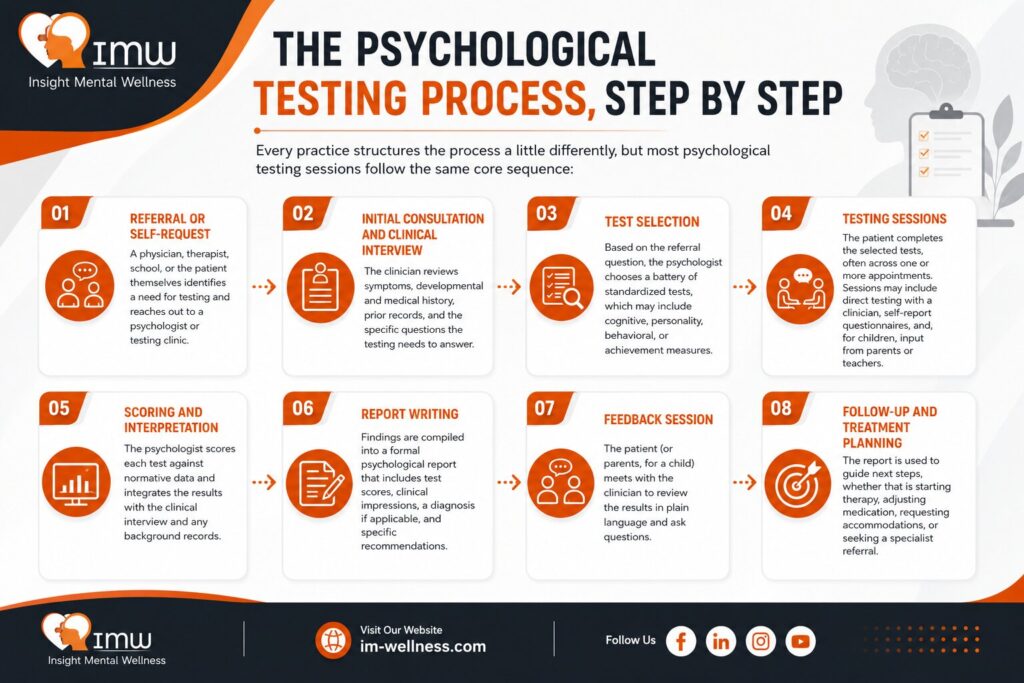
- Referral or self-request. A physician, therapist, school, or the patient themselves identifies a need for testing and reaches out to a psychologist or testing clinic.
- Initial consultation and clinical interview. The clinician reviews symptoms, developmental and medical history, prior records, and the specific questions the testing needs to answer.
- Test selection. Based on the referral question, the psychologist chooses a battery of standardized tests, which may include cognitive, personality, behavioral, or achievement measures.
- Testing sessions. The patient completes the selected tests, often across one or more appointments. Sessions may include direct testing with a clinician, self-report questionnaires, and, for children, input from parents or teachers.
- Scoring and interpretation. The psychologist scores each test against normative data and integrates the results with the clinical interview and any background records.
- Report writing. Findings are compiled into a formal psychological report that includes test scores, clinical impressions, a diagnosis if applicable, and specific recommendations.
- Feedback session. The patient (or parents, for a child) meets with the clinician to review the results in plain language and ask questions.
- Follow-up and treatment planning. The report is used to guide next steps, whether that is starting therapy, adjusting medication, requesting accommodations, or seeking a specialist referral.
What Happens During the Clinical Interview?
The clinical interview is usually the longest single appointment in the process. The psychologist asks about current symptoms, when they started, family and developmental history, past mental health treatment, medical conditions, and any prior testing. This conversation shapes which tests are selected in the next step, so accurate and detailed answers matter more than a quick summary.
What Types of Tests Are Used?
Psychological testing rarely relies on a single instrument. Most evaluations combine several categories of standardized tests, matched to the referral question:
|
Test Category |
What It Measures |
Common Use Case |
| Cognitive / IQ testing | Reasoning, memory, processing speed, problem-solving | Learning disability or giftedness evaluation |
| Personality testing | Emotional patterns, traits, coping style | Diagnostic clarification, treatment planning |
| Behavioral / attention testing | Attention span, impulsivity, activity level | ADHD evaluation in children and adults |
| Neuropsychological testing | Brain-behavior relationships, memory, executive function | Memory concerns, head injury, cognitive decline |
| Achievement testing | Reading, math, and academic skill levels | School accommodations, IEP or 504 requests |
How Long Does Psychological Testing Take?
A single testing session usually runs two to four hours, and a full evaluation typically requires one to three sessions depending on the number of tests involved. Scoring, interpretation, and report writing take additional time behind the scenes, generally one to three weeks. Most patients complete the entire process, from intake to feedback session, within three to six weeks. This timeline is consistent with the general assessment framework described in the NCBI clinical assessment overview, which outlines interviewing, testing, and interpretation as sequential stages of a complete evaluation.
How Are Psychological Test Results Scored and Interpreted?
Standardized psychological tests are scored against normative data, meaning a patient’s raw scores are compared to those of a large reference group of similar age or background. This is what allows a psychologist to say, for example, that a patient’s attention scores fall below the range typical for their age group. Interpretation goes beyond the numbers: the psychologist weighs the test scores alongside the clinical interview, behavioral observations, and any outside records to reach a diagnostic conclusion, rather than relying on a single score in isolation.
Psychological Testing vs. Psychological Assessment: What Is the Difference?
The terms are often used interchangeably, but they are not identical. Testing refers specifically to the administration of standardized instruments. Assessment is the broader process, which includes testing along with the clinical interview, behavioral observations, and a review of medical or school records. In practice, most patients undergo an assessment that includes formal testing as one component of a larger evaluation.
How to Prepare for a Psychological Testing Appointment
A little preparation makes the testing sessions go more smoothly and produces a more accurate result:
- Bring a photo ID, insurance card, and any referral paperwork
- Bring a list of current medications, including dosages
- Gather prior psychological, medical, or school records if available
- Get a full night’s sleep before each testing session
- Eat a normal meal beforehand; testing sessions can run several hours
- Wear glasses or hearing aids if you normally use them
- Arrive 15 to 30 minutes early to complete any remaining intake paperwork
Psychological Testing at Insight Mental Wellness in Dallas, TX
At Insight Mental Wellness, psychological testing follows this same structure: an initial consultation, standardized testing, scoring, a written report, and a feedback session where a licensed clinician walks you through the findings. Our Dallas-Fort Worth location offers evaluations for ADHD, autism spectrum disorder, PTSD, learning disabilities, and pre-operative psychological clearance, with both in-person and virtual components available depending on the type of evaluation.
Testing often leads directly into other care. If your results point toward a medication-responsive condition, our medication management team can take the next step, and our guide on how to choose a medication management clinic in Dallas walks through what to look for. If the recommendation is therapy instead, our individual, couples, and group therapy services are available at the same practice, so your feedback session can connect directly to a treatment plan rather than leaving you to find a new provider on your own.
We see patients at our Dallas-Fort Worth and San Antonio locations, and most major insurance plans are accepted. You can browse more articles on testing, medication management, and IV therapy on our blog, or contact us directly to ask whether testing is the right next step for your situation.
Frequently Asked Questions
What is psychological testing used for?
It is used to diagnose mental health, behavioral, and neurodevelopmental conditions, to guide treatment planning, and to support requests for school or workplace accommodations.
How long does psychological testing take?
Individual sessions typically run two to four hours. The full process, from intake to feedback session, usually takes three to six weeks.
Who performs psychological testing?
A licensed psychologist or a supervised trainee under a licensed psychologist administers and interprets the tests. Some evaluations also involve a psychiatric nurse practitioner or physician for the initial referral.
Is psychological testing covered by insurance?
Many insurance plans cover psychological testing when it is medically necessary, though coverage, required documentation, and the number of approved hours vary by plan. Checking benefits before scheduling is recommended.
What is the difference between psychological testing and a psychiatric evaluation?
A psychiatric evaluation is typically a clinical interview conducted by a psychiatrist or nurse practitioner to assess symptoms and consider medication. Psychological testing adds standardized, norm-referenced instruments to measure specific cognitive or emotional functions in more detail.
What should I bring to my testing appointment?
Bring photo ID, insurance information, a current medication list, and any prior psychological, medical, or school records you have available.
What happens after psychological testing?
You receive a written report and attend a feedback session where the clinician explains the results and recommends next steps, which may include therapy, medication management, or formal accommodations.
Can psychological testing be done virtually?
Some components, such as the clinical interview and certain questionnaires, can be completed virtually. Many standardized cognitive and performance-based tests still require an in-person session for accurate administration.
Key Takeaways
- Psychological testing follows a consistent sequence: consultation, testing, scoring, report, and feedback session
- A full evaluation usually takes three to six weeks from intake to feedback
- Testing combines several types of standardized instruments, chosen based on the referral question
- Assessment is broader than testing and includes interviews and records review alongside the formal tests
- Preparing records, medication lists, and a rested schedule improves the accuracy of your results
- Results connect directly to next steps, such as therapy, medication management, or school and workplace accommodations
If you are considering psychological testing in Dallas or Fort Worth, Insight Mental Wellness can walk you through whether testing fits your situation and schedule a consultation to get started.