If you’ve been prescribed medication for anxiety, depression, ADHD, or another mental health condition, you’ve probably run into two terms that sound almost identical: medication management and medication therapy management. They’re used interchangeably online, but in practice, they refer to two different services provided by two different types of clinicians, for two different purposes.
Understanding the difference matters because it determines who you should call, what to expect from your appointment, and how you’ll get the most benefit from your treatment. This guide breaks down what each service actually involves, who provides it, when you need one versus the other, and how they can work together as part of a coordinated care plan.
What Is Medication Management?
Medication management is the ongoing psychiatric process of evaluating, prescribing, adjusting, and monitoring medication for a mental health condition. It’s typically provided by a psychiatrist, psychiatric nurse practitioner, or another licensed prescriber as part of psychiatric care.
A typical medication management plan includes:
- An initial psychiatric evaluation to diagnose the condition and review medical and psychiatric history
- Selecting a starting medication and dose based on symptoms, prior treatment response, and any co-occurring conditions
- Scheduled follow-up visits to track how the medication is working
- Dose adjustments or medication changes based on symptom improvement or side effects
- Monitoring for interactions with other medications
- Coordination with a therapist, primary care provider, or other members of your care team
This is the service most people mean when they say they’re “seeing someone for meds.” Our medication management program is built around this ongoing, condition-specific process, with regular check-ins rather than a one-time prescription.
|
Quick definition: Medication management is the clinical oversight of psychiatric medication over time, diagnosing, prescribing, adjusting, and monitoring treatment for conditions like depression, anxiety, bipolar disorder, and ADHD. |
What Is Medication Therapy Management (MTM)?
Medication therapy management, often shortened to MTM, is a distinct, typically pharmacist-led service focused on reviewing a patient’s entire medication list, not just psychiatric prescriptions, to catch interactions, duplications, and safety issues.
MTM was formalized under Medicare Part D and is most often used for patients who:
- Take multiple medications across several prescribers (polypharmacy)
- Have two or more chronic conditions
- Meet a specific annual medication spend threshold set by their insurance plan
A standard MTM session includes a comprehensive medication review, often the core deliverable of the service, where a pharmacist walks through every medication, supplement, and over-the-counter drug a patient takes. The pharmacist checks for redundant prescriptions, dangerous combinations, and dosing errors, then sends a summary back to the prescribing physicians. It’s a safety and coordination service, not an ongoing treatment relationship. If you’ve ever wondered why a pharmacist called to review your prescriptions after a hospital stay, that was likely MTM.
|
Quick definition: Medication therapy management is a pharmacist-led medication review service that audits a patient’s full prescription list for safety, interactions, and appropriateness, usually as a periodic check-in rather than ongoing psychiatric treatment. |
Medication Management vs. Medication Therapy Management: Key Differences
| Medication Management | Medication Therapy Management (MTM) | |
| Typically provided by | Psychiatrist or psychiatric nurse practitioner | Pharmacist |
| Primary focus | One condition (often psychiatric) treated over time | Entire medication list, across all conditions |
| Setting | Psychiatric or medical practice | Pharmacy, health plan, or clinic-based program |
| Frequency | Ongoing, scheduled follow-ups | Often annual or triggered by a specific event |
| Goal | Find and maintain the right medication and dose | Catch interactions, duplications, and safety issues |
| Who typically qualifies | Anyone being treated for a diagnosed condition | Patients on multiple medications or chronic conditions, often Medicare Part D enrollees |
When Do You Need Medication Management vs. MTM?
The two services aren’t competing options, they answer different questions.
You likely need medication management if:
- You’ve been diagnosed with a mental health condition and need an active treatment plan
- Your current medication isn’t controlling your symptoms
- You’re experiencing side effects and need a dose adjustment
- You want a psychiatric provider who will track your progress over multiple visits
You likely need (or would benefit from) MTM if:
- You take five or more medications from different prescribers
- You’ve recently been discharged from the hospital and your medication list changed
- You want a pharmacist’s second opinion on whether all your prescriptions still make sense together
- Your insurance plan has flagged you as eligible for a covered MTM review
In many cases, the two work best together. A psychiatric provider manages the medication for your specific condition, while an MTM review makes sure that medication doesn’t conflict with anything else you’re taking.
Benefits of Each Approach
Benefits of Medication Management
Ongoing psychiatric medication management gives you a provider who actually knows your history rather than starting over at each visit. Our earlier breakdown of the benefits of medication management covers this in more depth, but the short version is: fewer trial-and-error cycles, faster identification of what’s working, and a clinician who can adjust course before a side effect becomes a bigger problem.
Benefits of MTM
MTM’s biggest strength is catching what individual prescribers can’t see on their own, the interactions and duplications that happen when three different doctors are each managing a piece of your health. It’s especially valuable for older adults and anyone managing several chronic conditions at once.
Common Conditions That Require Ongoing Medication Management
Several mental health conditions are managed almost entirely through this kind of long-term prescribing relationship rather than a one-time review:
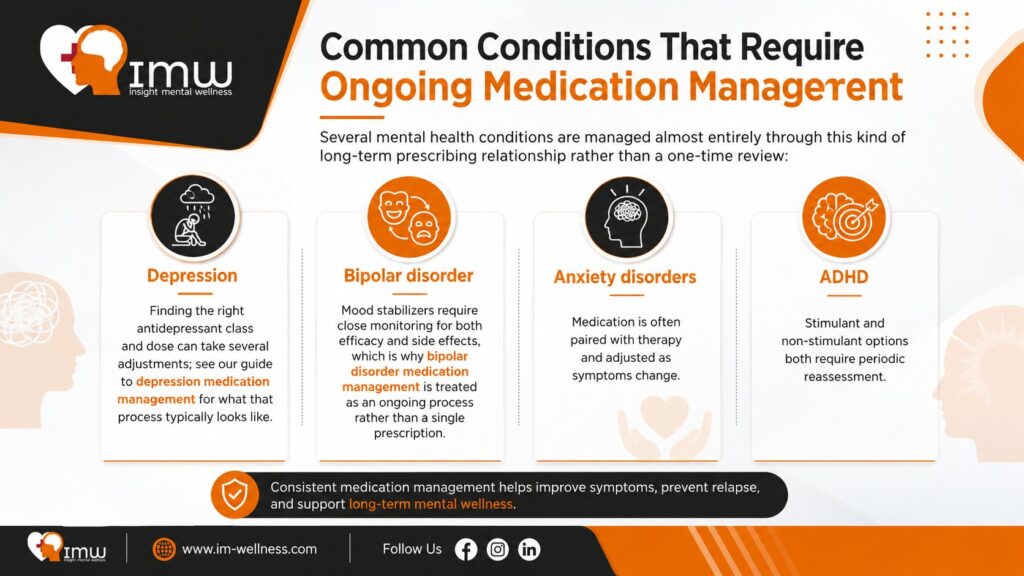
- Depression: finding the right antidepressant class and dose can take several adjustments; see our guide to depression medication management for what that process typically looks like.
- Bipolar disorder: mood stabilizers require close monitoring for both efficacy and side effects, which is why bipolar disorder medication management is treated as an ongoing process rather than a single prescription.
- Anxiety disorders: medication is often paired with therapy and adjusted as symptoms change.
- ADHD: stimulant and non-stimulant options both require periodic reassessment.
Across all of these, avoiding common medication mistakes, like stopping a medication abruptly or combining it with an over-the-counter product without checking first, is part of what a provider watches for at every follow-up.
|
Looking for medication management in Dallas? Our psychiatric providers offer ongoing evaluation, prescribing, and follow-up care for depression, anxiety, bipolar disorder, ADHD, and more. Schedule a consultation to get started. |
How Medication Management Works, Step by Step
- Initial evaluation. A psychiatric provider reviews your symptoms, history, and any prior medications you’ve tried.
- Personalized treatment plan. A starting medication and dose are selected based on your diagnosis and health profile.
- Early follow-up. Most patients return within a few weeks to check how the medication is working and screen for side effects, this is also when a provider talks through possible medication management side effects so nothing catches you off guard.
- Dose, timing, or medication itself may change based on your response.
- Maintenance visits. Once a medication is working, visits typically become less frequent but continue on a regular schedule.
- Your provider communicates with your therapist or primary care physician as needed.
Key Takeaways
- Medication management is ongoing psychiatric prescribing and monitoring for a diagnosed condition, usually provided by a psychiatrist or psychiatric nurse practitioner.
- Medication therapy management (MTM) is a pharmacist-led review of your entire medication list, focused on safety and interactions.
- The two aren’t interchangeable; one treats a condition over time, the other audits your prescriptions at a point in time.
- Many patients benefit from both, especially if they’re on multiple medications from different providers.
- Consistent follow-up, whichever service you use, is what actually prevents medication errors and treatment plateaus.
Frequently Asked Questions
Is medication management the same as medication therapy management?
No. Medication management is ongoing psychiatric treatment for a specific condition, typically provided by a prescriber. Medication therapy management is a pharmacist-led review of your full medication list, usually a periodic safety check rather than an ongoing treatment relationship.
Who can provide medication management?
Psychiatrists, psychiatric nurse practitioners, and other licensed prescribers with psychiatric training typically provide medication management.
How often are medication management appointments?
Follow-ups are usually more frequent when starting or adjusting a medication (every few weeks) and space out to monthly or quarterly once a stable, effective dose is reached.
Does insurance cover medication therapy management?
Many Medicare Part D plans cover MTM for eligible enrollees at no cost. Commercial insurance coverage varies, so it’s worth checking with your specific plan.
What happens during a comprehensive medication review?
A pharmacist walks through every prescription, over-the-counter medication, and supplement you take, checks for interactions or duplications, and sends a summary of recommendations to your prescribing providers.
Can I use both medication management and MTM at the same time?
Yes. They complement each other rather than overlap, one manages your psychiatric treatment, the other reviews your broader medication safety.
Getting Started
If you’re not sure which service fits your situation, that’s a normal place to start. A psychiatric provider can tell you within one evaluation whether ongoing medication management is the right path, and can flag if an MTM review would be worth adding on top of it. If you’re in the Dallas area, our medication management in Dallas program offers evaluations, ongoing prescribing, and follow-up care built around your specific diagnosis. Book an appointment to talk through your options with a provider.