Feeling mentally foggy, unfocused, or unusually drained can make even simple tasks feel harder. Poor sleep, dehydration, nutritional deficiencies, stress, illness, medication effects, and several underlying health conditions can all contribute to changes in concentration and energy.
That raises a common question: Can IV therapy support focus and mental clarity?
The answer is potentially, depending on why someone is experiencing fatigue or brain fog. IV therapy delivers fluids and selected nutrients directly into the bloodstream, which can be useful in specific situations. However, it should not be viewed as a guaranteed cognitive enhancer or a substitute for evaluating the underlying cause of persistent brain fog.
For some people, improving hydration or correcting a documented nutritional problem may help them feel more alert. For others, ongoing difficulty concentrating may require a broader medical evaluation rather than an IV infusion.
This guide explains what IV therapy can and cannot do for mental clarity, which factors may influence its effects, what to consider before treatment, and when persistent brain fog deserves medical attention.
Key takeaway: IV therapy may support how you feel when dehydration or certain nutritional issues are contributing to fatigue or poor concentration, but there is not strong evidence that routine vitamin IV infusions improve focus in otherwise healthy people.
What Is IV Therapy?
IV therapy, or intravenous therapy, is a medical treatment that delivers fluids, vitamins, minerals, electrolytes, or other prescribed substances directly into a vein. Because the substances enter the bloodstream directly, IV administration bypasses the digestive tract.
The exact contents of an infusion vary according to the treatment plan and clinical setting. Some infusions primarily provide fluids and electrolytes, while others may contain selected vitamins or nutrients.
If you’re new to the subject, our guide to IV Therapy 101 can provide helpful background before considering a treatment.
Can IV Therapy Improve Focus and Mental Clarity?
IV therapy may help support mental clarity when dehydration or a clinically relevant nutritional issue is contributing to fatigue or difficulty concentrating. However, research does not establish routine IV vitamin therapy as a proven treatment for brain fog or a general-purpose cognitive enhancer.
This distinction matters.
A person who feels mentally sluggish after significant fluid loss may feel better after appropriate hydration. Dehydration has been associated with changes in attention and cognitive performance in some research, although findings across studies are not completely consistent.
That does not mean an IV infusion automatically makes someone more focused.
The potential benefit depends largely on what is causing the symptoms in the first place.
Focus and mental clarity can be affected by many factors
Common contributors to brain fog or reduced concentration include:
- Inadequate sleep
- Dehydration
- Acute illness
- Poor dietary intake
- Nutritional deficiencies
- Stress and emotional strain
- Certain medications
- Alcohol or substance use
- Hormonal changes
- Anemia
- Thyroid disorders
- Blood glucose abnormalities
- Anxiety or depression
- Sleep disorders
- Other underlying medical conditions
An IV cannot correct every cause on this list.
That is why a responsible approach begins with understanding the person’s symptoms rather than assuming that a particular infusion is the answer.
How Could IV Therapy Support Mental Clarity?
There are several potential pathways worth understanding.
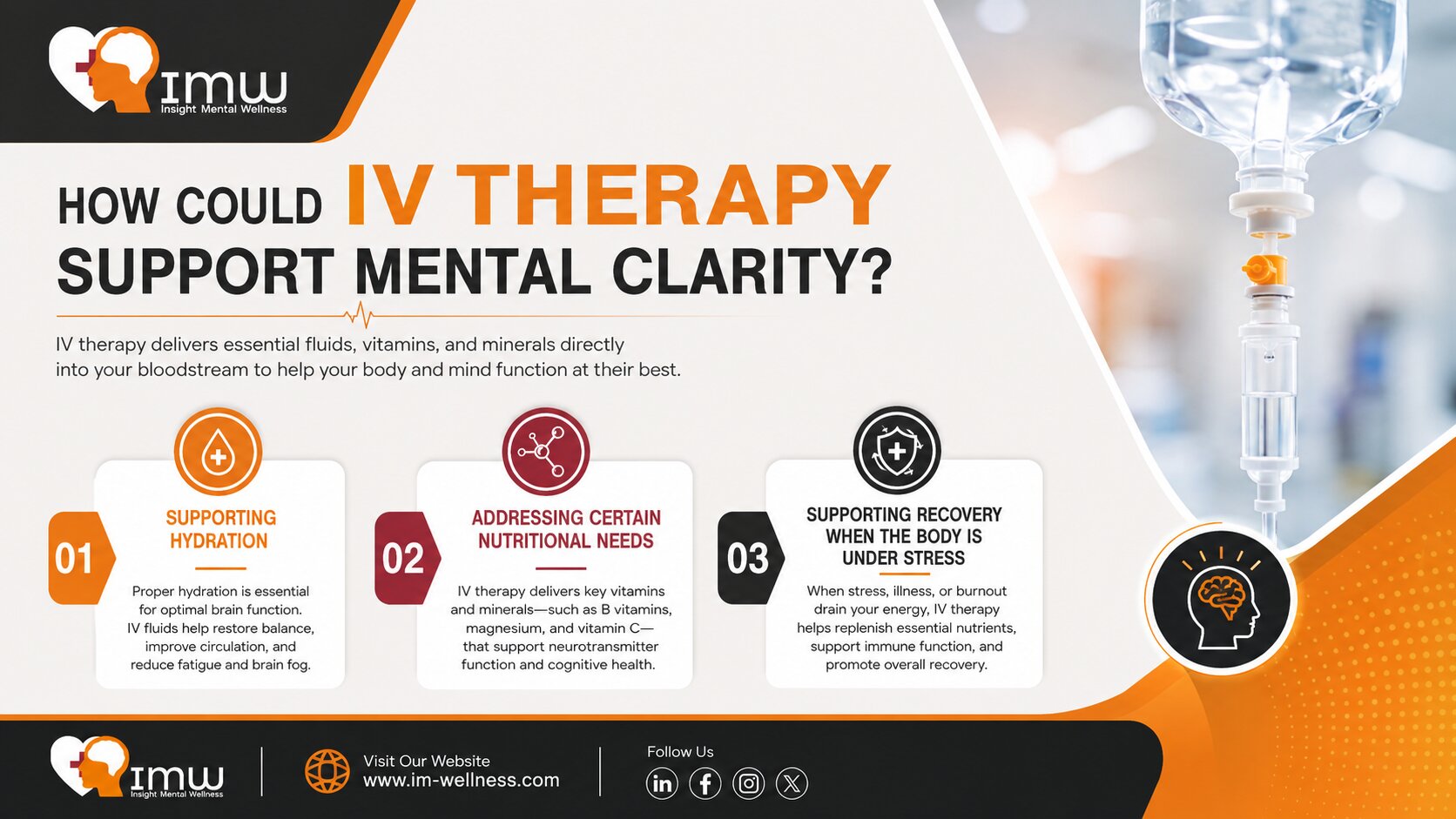
1. Supporting hydration
Fluids are essential for normal physiological function. When someone is significantly dehydrated, symptoms can include fatigue, headache, dizziness, and feeling less mentally sharp.
Appropriate fluid replacement may help when dehydration is genuinely contributing to those symptoms.
However, IV fluids are not inherently superior to drinking fluids for routine hydration. For many healthy people with mild dehydration, oral fluids are sufficient.
IV hydration may be considered when oral intake is inadequate, inappropriate, or when a clinician determines that intravenous replacement is warranted.
2. Addressing certain nutritional needs
Some IV formulations contain vitamins or minerals involved in normal cellular and neurological function.
For example, nutrients such as:
- Vitamin B12
- Folate
- Thiamine
- Magnesium
- Vitamin C
have important physiological roles.
But an important distinction is often missed in wellness marketing:
The fact that a nutrient is important does not automatically mean that giving more of it intravenously will improve cognition.
Someone with a true nutritional deficiency may benefit from appropriate treatment. Someone without a deficiency may not experience the same benefit from receiving additional nutrients.
3. Supporting recovery when the body is under stress
People sometimes seek IV therapy during periods of intense fatigue, travel, illness recovery, demanding schedules, or inadequate fluid intake.
In these situations, an infusion may be part of a broader wellness or recovery plan when clinically appropriate.
Still, persistent fatigue should not simply be treated as a hydration problem without considering other possible causes.
What Does the Evidence Say About IV Therapy and Brain Fog?
This is where a careful distinction between plausibility and proof is important.
There is a reasonable physiological basis for correcting dehydration or a genuine nutrient deficiency. But that is different from demonstrating that vitamin infusions reliably improve concentration in healthy adults.
Research on hydration and cognition itself is mixed. One meta-analysis found small but statistically significant cognitive impairments associated with dehydration, particularly in areas such as attention and executive function, while another systematic review found no clear overall impairment across cognitive domains.
This means it would be inappropriate to promise that IV hydration will improve everyone’s focus.
The most evidence-based approach is to ask:
What is causing the person’s fatigue or difficulty concentrating?
If dehydration is part of the problem, restoring fluid balance makes physiological sense. If a deficiency is present, correcting it may be appropriate. If the real issue is sleep deprivation, depression, medication effects, thyroid disease, or another condition, treating that underlying problem is more important.
IV Therapy vs. Other Ways to Support Mental Clarity
IV therapy is only one possible component of a wellness or medical plan.
| Approach | What it may address | Important consideration |
|---|---|---|
| Adequate sleep | Fatigue, attention, memory | Often foundational for cognitive performance |
| Oral hydration | Mild dehydration | Usually appropriate for routine fluid replacement |
| Balanced nutrition | Overall nutrient intake | Food remains an important source of essential nutrients |
| Exercise | Energy, mood, overall health | Benefits depend on consistency and individual health |
| Treating a nutritional deficiency | Deficiency-related symptoms | Should be guided by clinical assessment |
| IV therapy | Selected hydration/nutrient needs | Should be individualized and medically appropriate |
| Medical evaluation | Persistent or unexplained brain fog | Can identify underlying conditions |
This comparison highlights an important point: IV therapy should complement appropriate healthcare rather than replace basic health habits or necessary medical evaluation.
What’s Actually in an IV Drip?
An IV drip is not a single standardized treatment.
Depending on the clinical purpose, an infusion may contain fluids, electrolytes, vitamins, minerals, or other medically appropriate ingredients.
The formulation should be based on the patient’s circumstances rather than a one-size-fits-all assumption.
Before treatment, it is reasonable to ask:
- What exactly is in the infusion?
- Why is each ingredient being included?
- What dose is being administered?
- Is there a medical reason for the ingredients?
- Are there medications or conditions that could make the treatment inappropriate?
- Who is evaluating and monitoring the treatment?
- Where are the ingredients sourced from?
- What should I expect during and after the infusion?
For additional background, see What’s Actually in an IV Drip.
Why individualized treatment matters
More ingredients do not necessarily mean better results.
Certain vitamins and minerals can cause adverse effects at excessive doses, and some people may have medical conditions that make particular ingredients inappropriate.
A qualified healthcare professional should consider relevant medical history, medications, allergies, kidney function, pregnancy status when applicable, and other factors before recommending treatment.
When Might IV Therapy Be Worth Considering?
IV therapy may be worth discussing with a qualified healthcare professional when someone:
- Has difficulty maintaining adequate hydration
- Cannot tolerate sufficient oral fluids
- Has a clinically identified nutritional issue
- Is experiencing fatigue in a context where hydration or nutrient support may be relevant
- Wants to understand whether an infusion is appropriate for their individual circumstances
It is less appropriate to approach IV therapy as a guaranteed solution for unexplained, persistent brain fog.
A practical example
Consider two people who both say, “I can’t focus.”
Person A has had poor fluid intake, has been sweating heavily, and feels tired and lightheaded. After appropriate assessment, hydration may be one reasonable component of care.
Person B has experienced concentration problems for six months along with poor sleep and persistent low mood. An IV infusion alone does not address the potential causes. That person may benefit more from a comprehensive medical and mental health evaluation.
The symptom is the same. The appropriate response may be completely different.
Can IV Therapy Replace Sleep, Nutrition, or Mental Health Care?
No.
IV therapy should not be considered a replacement for:
- Consistent, restorative sleep
- Adequate nutrition
- Regular physical activity when medically appropriate
- Appropriate hydration
- Treatment of mental health conditions
- Medication management when prescribed
- Evaluation of persistent or unexplained symptoms
Mental clarity is influenced by the interaction of physical health, mental health, sleep, nutrition, medications, and lifestyle.
If brain fog is persistent or interfering with work, school, relationships, or daily activities, the more useful question may be why it is happening rather than simply how to make it disappear temporarily.
IV Therapy vs. IM Injections: What’s the Difference?
IV therapy and intramuscular (IM) injections both deliver substances without relying on the digestive system, but they are administered differently.
IV therapy delivers the substance directly into a vein, while an IM injection places medication or another appropriate substance into muscle tissue.
The route can affect how a substance is absorbed and how quickly it reaches systemic circulation.
Neither route is automatically “better.” The appropriate method depends on the substance being administered, the clinical goal, the patient’s circumstances, and the healthcare professional’s judgment.
Learn more in IV Therapy vs. IM Injections.
How IV Therapy Is Administered
During IV therapy, a healthcare professional typically:
- Reviews relevant health information.
- Determines whether IV therapy is appropriate.
- Selects the appropriate infusion based on the treatment plan.
- Inserts a small IV catheter into a vein.
- Administers the infusion while monitoring the patient as appropriate.
- Removes the IV catheter when treatment is complete.
The exact experience varies depending on the formulation and clinical setting.
Is IV Therapy Safe?
IV therapy can be appropriate when properly selected and administered, but “wellness treatment” does not mean risk-free.
Potential risks may include:
- Pain or bruising at the injection site
- Vein irritation
- Infection
- Fluid or electrolyte problems
- Allergic or infusion reactions
- Side effects associated with individual ingredients
- Problems related to excessive or inappropriate dosing
There are also important quality considerations when compounded sterile products are involved. The FDA has specifically raised concerns about the safety and quality of compounded products used in IV hydration settings and emphasizes appropriate sourcing, evaluation, and sterile-compounding practices.
This is one reason consumers should look beyond attractive treatment menus and ask about clinical oversight, product sourcing, patient evaluation, and safety procedures.
Safety matters: IV therapy places substances directly into the bloodstream. Choosing a qualified medical provider and receiving an appropriate clinical assessment is an important part of reducing avoidable risk.
Who Should Talk to a Healthcare Professional Before IV Therapy?
Anyone considering IV therapy should disclose relevant health information before treatment.
Extra caution may be appropriate for people with:
- Kidney problems
- Heart conditions
- Fluid-balance concerns
- Electrolyte abnormalities
- Medication interactions
- Known allergies
- Pregnancy or breastfeeding
- A history of reactions to IV treatments
- Conditions requiring fluid restriction
The appropriate infusion, dosage, and route can vary significantly from person to person.
When Is Brain Fog a Sign You Should Look Deeper?
Occasional tiredness or difficulty concentrating is common.
Persistent or worsening cognitive symptoms deserve more attention, particularly when they are accompanied by other changes.
Consider speaking with a healthcare professional if you experience:
- Brain fog that persists for weeks or months
- Significant daytime sleepiness
- New or worsening headaches
- Unexplained weakness or dizziness
- Changes in mood
- Memory problems
- Significant changes in sleep
- Changes that began after starting or changing medication
- Symptoms that interfere with work or daily responsibilities
A medical evaluation can help distinguish a hydration issue from nutritional, neurological, psychiatric, hormonal, sleep-related, or other causes.
If you’re considering IV therapy for hydration, wellness, or nutrient support, the right starting point is understanding whether it fits your individual needs.
Insight Mental Wellness provides IV Therapy in Dallas with an individualized approach focused on appropriate treatment and patient safety. Rather than assuming every person needs the same infusion, discuss your goals and health history with a qualified provider.
How to Get the Most From an IV Therapy Consultation
Before scheduling an infusion, prepare a few questions.
Questions to ask your provider
- What is the goal of this IV treatment?
- What ingredients will I receive?
- Why are these ingredients appropriate for me?
- Is there evidence supporting their use for my specific concern?
- Are there any medications or medical conditions that could affect treatment?
- How long will the infusion take?
- What side effects should I watch for?
- What happens if I experience a reaction?
- Is additional testing or evaluation recommended?
- How will you determine whether the treatment is helping?
These questions shift the conversation from “Which drip should I buy?” to “Is this treatment medically appropriate for me?”
That is a much more useful starting point.
Common Misconceptions About IV Therapy and Mental Clarity
Myth: IV vitamins automatically improve concentration
Not necessarily.
Correcting dehydration or a nutritional deficiency may help someone feel better when those factors are contributing to symptoms. But there is not sufficient evidence to claim that routine IV vitamin infusions reliably enhance cognitive performance in everyone.
Myth: More vitamins mean more mental energy
More is not always better.
Nutrients have physiological roles and appropriate ranges. Unnecessary or excessive supplementation can create risks rather than benefits.
Myth: Brain fog always means dehydration
No.
Dehydration is one possible contributor, but sleep problems, stress, mental health conditions, medications, nutritional issues, endocrine disorders, and other medical conditions can also cause cognitive symptoms.
Myth: IV therapy is always better than oral hydration
No.
For ordinary hydration needs, drinking fluids is often sufficient. IV therapy has a specific medical role and should not be treated as a universally superior hydration method.
IV Therapy 101: What to Remember
If you’re considering an IV infusion for focus, energy, or mental clarity, keep these principles in mind:
- Identify the problem first. Brain fog has many potential causes.
- Do not confuse physiological plausibility with proven benefit.
- Hydration can matter, but IV fluids are not automatically necessary.
- Nutrient replacement is most meaningful when there is an appropriate clinical reason.
- Individualization matters. The same infusion is not appropriate for everyone.
- Ask about safety and sourcing. Injectable products require careful quality control.
- Persistent symptoms deserve evaluation. An IV should not mask an underlying health problem.
Key Takeaways
Can IV therapy support focus and mental clarity? It can potentially help when dehydration or certain nutritional issues are contributing to fatigue or reduced concentration, but it should not be marketed as a guaranteed cognitive enhancer.
The most important considerations are:
- Determine why you’re experiencing brain fog.
- Address basic factors such as sleep, hydration, nutrition, and stress.
- Use IV therapy only when it is appropriate for your individual situation.
- Choose a qualified provider with appropriate clinical oversight.
- Seek medical evaluation when concentration problems are persistent, severe, or unexplained.
Mental clarity is rarely about one intervention. The goal should be to identify the factors affecting how you feel and address them appropriately.
FAQs
1. Can IV therapy help with brain fog?
IV therapy may help if dehydration or an appropriate nutritional issue is contributing to fatigue or brain fog. However, there is not strong evidence that routine IV vitamin therapy improves cognitive function in otherwise healthy people. Persistent brain fog should be evaluated for underlying causes.
2. What vitamins are commonly included in IV therapy for energy?
Depending on the treatment plan, IV formulations may contain nutrients such as B vitamins, vitamin C, magnesium, or electrolytes. The appropriate ingredients and doses depend on the individual’s health needs and should be determined by a qualified healthcare professional.
3. How quickly can IV therapy improve mental clarity?
There is no reliable universal timeline. If symptoms are related to dehydration or another factor that an infusion appropriately addresses, someone may notice changes relatively quickly. However, IV therapy should not be expected to immediately resolve brain fog caused by sleep disorders, mental health conditions, medication effects, nutritional deficiencies requiring longer-term treatment, or other medical problems.
4. Is IV therapy better than drinking water for mental clarity?
Not routinely. For ordinary hydration, oral fluids are generally sufficient. IV fluids may be appropriate in selected clinical circumstances when oral hydration is inadequate or another medical reason supports intravenous treatment.
5. Is IV therapy safe?
IV therapy can be safely administered in appropriate circumstances, but it carries risks including infection, vein irritation, infusion reactions, and risks related to individual ingredients or inappropriate dosing. The safety of the treatment depends on patient selection, proper administration, appropriate products, and clinical oversight. FDA has highlighted quality and safety concerns involving some compounded products used in IV hydration settings.
6. Should I get IV therapy if I have persistent brain fog?
Persistent brain fog should not automatically be treated with IV therapy. If concentration problems continue or interfere with daily life, speak with a healthcare professional to determine whether sleep, medications, nutrition, mental health, thyroid function, anemia, hydration, or another condition could be contributing.
Final Thoughts
IV therapy may have a role in supporting hydration and selected nutritional needs, but mental clarity is not something that can be reduced to a single IV drip.
If dehydration or a specific nutrient issue is contributing to fatigue, appropriate treatment may help. If the underlying cause is poor sleep, stress, medication effects, depression, anxiety, or another health condition, addressing that cause is more important than simply seeking a temporary boost.
If you’re considering IV therapy in Dallas, start with a conversation about your goals, health history, medications, and whether an infusion is appropriate for you. Learn more about IV Therapy in Dallas or explore Insight Mental Wellness’s IV Therapy services to understand your options.