Starting ADHD medication is rarely the hard part. The hard part is what comes after — the dose adjustments, the side effects that show up in week three, the days a medication seems to “stop working,” and the ongoing back-and-forth with a prescriber to find something that actually fits your life. This is where most people get stuck, and it’s exactly what medication management for ADHD is designed to solve.
This guide walks through what ADHD medication management actually involves, how it differs from simply “being on medication,” what the process looks like month to month, and how to know if your current plan is working the way it should. It’s written for adults and parents of children with ADHD who want a clear, practical understanding of the process, not just a list of drug names.
Key Takeaways
- ADHD medication management is an ongoing clinical process — not a one-time prescription- involving dose titration, monitoring, and regular follow-up.
- Stimulants (methylphenidate and amphetamine-based) are first-line for most patients; non-stimulants are used when stimulants aren’t tolerated or appropriate.
- Effective management typically includes symptom tracking, side effect monitoring, and periodic reassessment every 1–3 months, longer once stable.
- A mismatch between dose and symptoms is common in the first 8–12 weeks and usually correctable; it doesn’t mean the medication has “failed.”
- Combining medication with behavioral strategies produces better long-term outcomes than medication alone for most patients.
What Is ADHD Medication Management?
ADHD medication management is the ongoing clinical process of prescribing, monitoring, and adjusting medication to control ADHD symptoms while minimizing side effects. It includes an initial evaluation, a titration period to find the right dose, regular follow-up visits, and periodic reassessment as a person’s needs change over time — whether due to age, weight, stress, co-occurring conditions, or life transitions like starting college or a new job.
It is distinct from simply “taking ADHD medication.” Medication management is the system around the prescription: the monitoring, the adjustments, the coordination with therapy or coaching, and the decision-making that keeps treatment effective over months and years.
Read More: What Is Medication Management
Who Provides ADHD Medication Management?
- Psychiatrists — typically handle complex cases, co-occurring mental health conditions, or when initial treatment hasn’t worked
- Primary care physicians — often manage straightforward cases, especially in adults with no complicating factors
- Psychiatric nurse practitioners (PMHNPs) — increasingly common prescribers for both children and adults
- Pediatricians — frequently manage childhood ADHD medication, sometimes with input from a child psychiatrist
How ADHD Medication Management Works: The Process
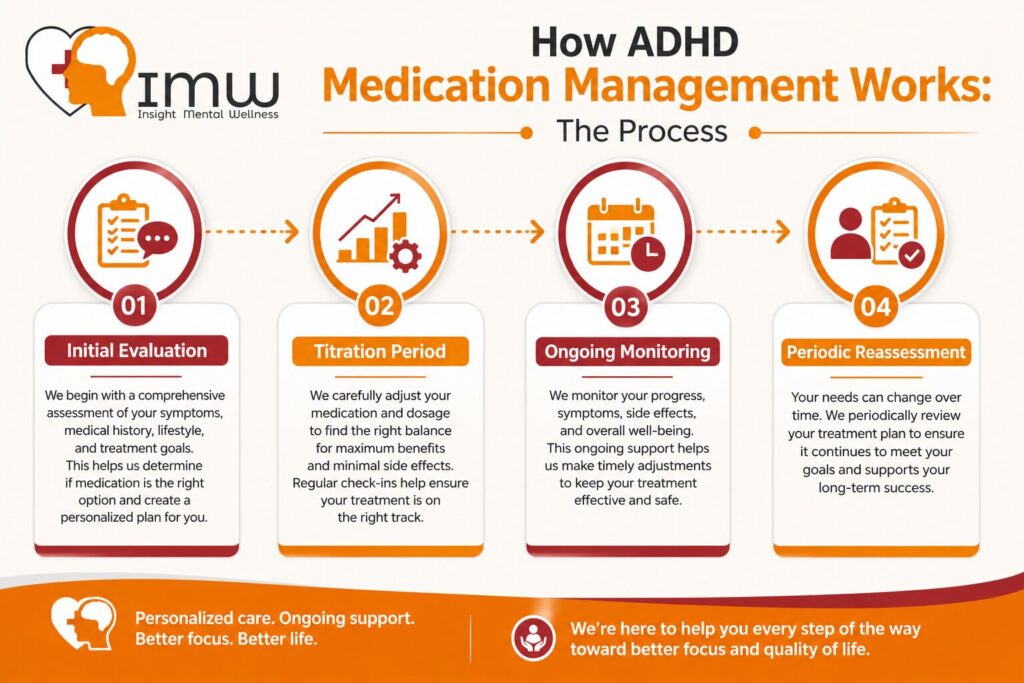
1. Initial Evaluation
Before any prescription, a thorough evaluation should include a symptom history, review of prior treatments, screening for co-occurring conditions (anxiety, depression, learning disorders, sleep issues), a cardiovascular history, and for some patients, a baseline blood pressure and heart rate check. Stimulant medications carry cardiovascular considerations, so this step matters even when it feels like an unnecessary delay.
2. Titration Period
Titration is the process of starting at a low dose and gradually increasing it to find the lowest effective dose with the fewest side effects. This phase typically takes 4–8 weeks and is the part patients find most frustrating, because the first dose is rarely the final dose.
What to expect during titration:
- Dose changes every 1–2 weeks based on response
- Side effects (appetite suppression, trouble sleeping, mild irritability) that often improve as the body adjusts
- A “start low, go slow” approach, especially in children and older adults
3. Ongoing Monitoring
Once a stable, effective dose is found, monitoring shifts to a maintenance schedule. This is where medication management earns its name — it’s not “set it and forget it.”
Standard monitoring includes:
- Follow-up visits every 1–3 months during the first year
- Blood pressure and heart rate checks at each visit (for stimulants)
- Height and weight tracking in children
- Symptom rating scales (such as the Vanderbilt or ASRS) to track progress objectively
- Screening for new or worsening side effects
4. Periodic Reassessment
ADHD treatment isn’t static. A dose that works well at age 9 may need adjustment by age 13. An adult whose symptoms were well-controlled may find that a new job with heavier cognitive demands requires a different approach. Reassessment every 6–12 months once stable is standard practice, and any major life change is a reasonable trigger for an earlier check-in.
Types of ADHD Medication
Understanding the two main categories helps make sense of what a prescriber is actually managing.
| Category | Examples | Onset | Common Use Case |
|---|---|---|---|
| Stimulants (methylphenidate-based) | Ritalin, Concerta, Focalin, Daytrana | 30–60 min (immediate-release) | First-line for most children and adults |
| Stimulants (amphetamine-based) | Adderall, Vyvanse, Dexedrine | 30–60 min (immediate-release); Vyvanse is a prodrug with gradual onset | First-line alternative; often used when methylphenidate isn’t effective |
| Non-stimulants | Strattera (atomoxetine), Qelbree (viloxazine) | 2–6 weeks for full effect | History of substance use, stimulant side effects, or co-occurring anxiety |
| Alpha-2 agonists | Intuniv, Kapvay | 1–2 weeks | Often combined with stimulants; helpful for impulsivity, tics, or sleep issues |
Stimulants vs. Non-Stimulants: Key Differences
- Speed of effect: Stimulants work within an hour; non-stimulants take weeks to reach full effect.
- Controlled substance status: Stimulants are Schedule II controlled substances with stricter prescribing rules (no automatic refills, monthly pickup in many states); non-stimulants are not controlled.
- Side effect profile: Stimulants more commonly affect appetite and sleep; non-stimulants more commonly cause fatigue or mild stomach upset.
- Abuse potential: Non-stimulants are generally preferred when there’s a history of substance misuse.
Common Side Effects and How Management Addresses Them
Side effects are one of the biggest reasons people stop ADHD medication prematurely, often within the first few weeks, before a prescriber has had the chance to adjust the plan. Good medication management anticipates this rather than reacting to it after the fact.
Frequently reported side effects:
- Decreased appetite (very common with stimulants, usually most noticeable at lunch)
- Trouble falling asleep, especially with afternoon dosing
- Mild increase in heart rate or blood pressure
- Irritability as the medication wears off (“rebound”)
- Dry mouth, headache, or mild stomach upset
How these are typically managed:
- Adjusting dose timing (earlier dosing, or switching to a shorter-acting formulation)
- Scheduling larger meals when appetite is highest (often breakfast, before the first dose)
- Adding a small immediate-release dose to smooth out rebound effects
- Switching medication class entirely if side effects persist despite adjustments
Looking for this kind of structured, closely-monitored care? Insight Mental Wellness offers Medication Management in Dallas built around exactly this process.
Signs Your ADHD Medication Plan Needs Adjustment
It’s common to assume a medication “isn’t working” when, in fact, the dose, timing, or formulation needs tweaking. Signs worth bringing to a prescriber:
- Symptoms return noticeably before the next dose (wearing off too early)
- Improvement in focus but new or worsening anxiety, irritability, or flatness of mood
- Effectiveness fading after months of good control (tolerance)
- Side effects that haven’t improved after 4+ weeks
- Good symptom control at school or work but not at home, or vice versa (may indicate a timing or coverage issue, not a treatment failure)
This is a normal part of the process. Most people make at least one adjustment in their first year of treatment, and many make several before landing on the right combination.
Medication Alone Isn’t the Whole Picture
Research consistently shows that combining medication with behavioral therapy, coaching, or structured skill-building produces better outcomes than medication alone, particularly for children and increasingly recognized for adults managing ADHD alongside work and relationship demands. Medication addresses the neurochemical piece; therapy and coaching address the habits, systems, and coping strategies that medication doesn’t create on its own.
A well-rounded ADHD treatment plan often includes:
- Medication management with a prescriber
- Behavioral therapy or ADHD coaching
- Environmental and organizational strategies (routines, reminders, workspace setup)
- Regular sleep and exercise habits, which measurably affect symptom severity
- School or workplace accommodations where appropriate
What to Expect at a Medication Management Appointment
A typical follow-up visit is shorter than the initial evaluation but more focused. Knowing what to expect helps patients (and parents) use the time well.
A standard visit usually covers:
- Review of symptoms since the last visit — what’s improved, what hasn’t
- Side effect check-in, including appetite, sleep, and mood
- Blood pressure and heart rate check (for stimulant patients)
- Discussion of any dose or timing changes
- Prescription renewal, which for controlled substances typically requires an in-person or telehealth visit each month in many states
Coming prepared with specific notes — times of day symptoms are worst, what a “bad day” looks like, any missed doses — makes these visits significantly more productive than a general “it’s going okay.”
For patients in North Texas, Medication Management in Dallas programs often builds this kind of structured, appointment-by-appointment tracking directly into the treatment plan, which tends to shorten the time it takes to reach a stable, effective dose.
Read More: What to Expect During a Medication Management Appointment?
ADHD Medication Management for Adults vs. Children
| Factor | Children | Adults |
|---|---|---|
| Common first-line approach | Stimulant + behavioral therapy combined | Stimulant or non-stimulant, often alongside coaching |
| Monitoring focus | Growth (height/weight), school performance | Work performance, relationships, sleep, cardiovascular history |
| Visit frequency | Often more frequent initially due to growth and dose changes | Every 1–3 months during titration, then quarterly or biannually |
| Common complicating factors | Tics, anxiety, oppositional behavior | Anxiety, depression, substance use history, sleep disorders |
Adult ADHD medication management has grown substantially as awareness of adult ADHD has increased, and many adults are diagnosed and treated for the first time in their 30s, 40s, or later — the management principles are the same, but the evaluation puts more weight on cardiovascular history and any history of substance use.
FAQs
How long does it take to find the right dose for ADHD medication management?
Most patients reach a stable, effective dose within 4–8 weeks, though some cases take longer, especially when trying multiple medications or managing co-occurring conditions.
Do I need to stay on ADHD medication forever?
Not necessarily. Some people use medication long-term, others use it during specific life phases (school years, high-demand work periods), and some transition off with a prescriber’s guidance once skills and strategies are established. This is a decision made collaboratively, not a fixed rule.
Can ADHD medication management help if a previous medication didn’t work?
Yes — a prior medication not working often means the wrong medication, dose, or formulation was tried, not that medication treatment as a whole has failed. Switching classes (stimulant to non-stimulant, or between stimulant types) resolves this in many cases.
Is it normal to feel “off” or flat on ADHD medication?
A flattened or “zombie-like” feeling is a common side effect, particularly at higher doses, and is a signal for a prescriber to adjust the dose or try a different medication rather than something to push through.
How often will I need appointments once my dose is stable?
Once stable, most patients move to visits every 3–6 months, partly for clinical monitoring and partly because stimulant prescriptions are controlled substances requiring regular prescriber contact in most states.
Can I combine ADHD medication with therapy or coaching?
Yes, this is generally recommended. Medication and behavioral approaches address different parts of ADHD, and combining them tends to produce more durable results than either alone.
The Bottom Line
ADHD medication management is a process, not a prescription handed over once and left alone. It involves careful titration, regular monitoring, honest conversations about what’s working and what isn’t, and a willingness to adjust, sometimes more than once, before landing on the right fit. Anyone starting or currently navigating ADHD medication should expect this back-and-forth as a normal, expected part of good care, not a sign that something has gone wrong.
If your current plan doesn’t feel right, whether it’s side effects that haven’t improved, symptoms creeping back before your next dose, or simply not knowing what “working well” is supposed to feel like — that’s worth raising with a provider who treats ADHD regularly, not just occasionally.
Insight Mental Wellness provides Medication Management in Dallas, with structured follow-ups, ongoing symptom tracking, and prescribers who adjust your plan until it actually fits your life — not the other way around. Schedule a consultation to get your treatment back on track.