If you’ve searched for “medication management in Dallas,” you’ve probably noticed something frustrating: dozens of practices claim to offer it, but almost none explain what actually separates a good provider from a mediocre one. That gap matters. The right psychiatric medication management provider can stabilize your mood, sharpen your focus, or finally make anxiety manageable. The wrong one can leave you cycling through medications with no clear plan, rushed 10-minute appointments, and a prescriber who barely remembers your name.
This guide breaks down exactly how to evaluate a medication management provider in Dallas — what credentials actually matter, which red flags to watch for, what a real treatment plan looks like, and the questions worth asking before you book that first appointment. Whether you’re dealing with depression, anxiety, ADHD, bipolar disorder, or another condition that needs ongoing pharmacological support, the goal is the same: find a provider who treats medication management as a relationship, not a transaction.
Quick Answer: A qualified medication management provider in Dallas should be a licensed psychiatrist, psychiatric nurse practitioner (PMHNP), or physician assistant working under psychiatric supervision, someone who conducts thorough evaluations, monitors side effects and lab work when needed, adjusts dosages based on measurable outcomes, and coordinates with any therapist you’re seeing. Look for board certification, transparent pricing, and appointment lengths that allow for real clinical conversation, not just a prescription refill.
What Is Medication Management, Exactly?
Medication management is the ongoing clinical process of prescribing, monitoring, and adjusting psychiatric medications to treat mental health conditions safely and effectively. It’s not a one-time prescription; it’s a continuous cycle of evaluation, dosage adjustment, side-effect monitoring, and collaboration between patient and prescriber.
A proper medication management visit typically includes:
- Reviewing how the current medication is working (or not working)
- Screening for side effects, drug interactions, or emerging symptoms
- Adjusting dosage or switching medications based on clinical response
- Discussing lifestyle factors that affect treatment (sleep, substance use, stress)
- Coordinating care with a therapist, primary care doctor, or specialist
This differs from a general checkup because it’s condition-specific and outcome-driven. A psychiatrist or psychiatric nurse practitioner tracks your response over weeks and months, not just at a single visit.
Read More: What Is Medication Management
Why Choosing the Right Provider Matters More Than You Think
Psychiatric medications aren’t one-size-fits-all. Two people with the same diagnosis can respond completely differently to the same drug. This is why the provider’s skill in titrating dosages, recognizing side effects, and adjusting course matters just as much as the medication itself.
A rushed or under-qualified provider tends to make one of two mistakes:
- Under-treating — keeping a patient on an ineffective dose because appointments are too short to properly reassess
- Over-prescribing — adding medications to manage side effects instead of addressing the root cause
Both outcomes are common, and both are avoidable with the right provider relationship. If you’re comparing options for medication management in Dallas, the provider’s approach to ongoing monitoring, not just their initial diagnosis, is what will determine your long-term outcome.
Ready to talk to someone? Insight Mental Wellness offers medication management in Dallas. Schedule a consultation anytime.
Types of Medication Management by Condition
Not all medication management is the same. The clinical approach shifts depending on what’s being treated. Here’s how it typically breaks down:
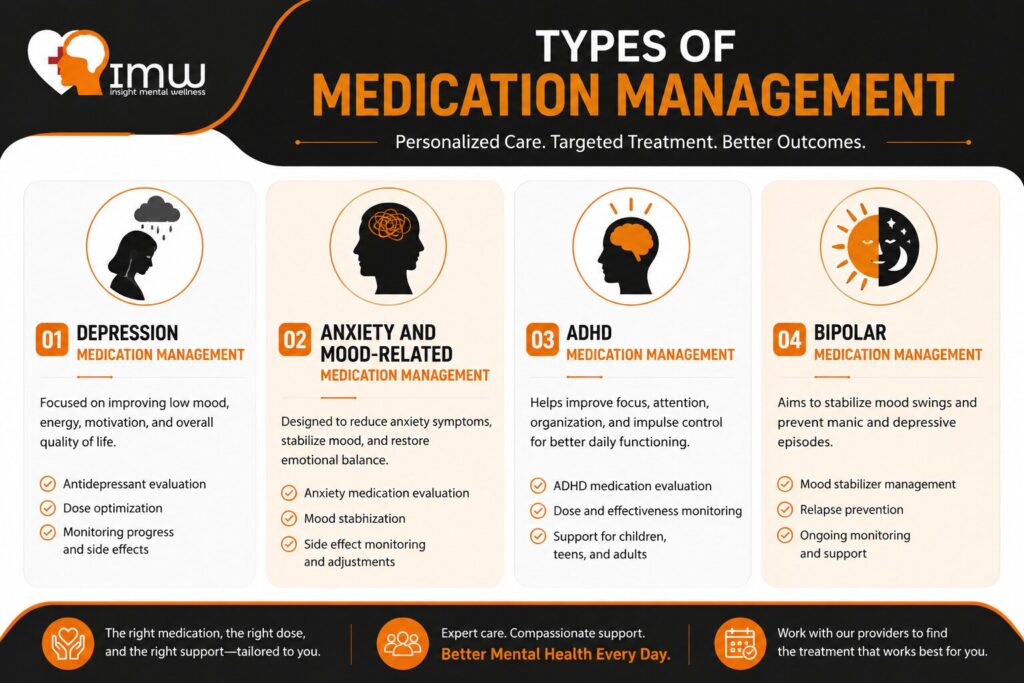
Depression Medication Management
Focuses on antidepressants (SSRIs, SNRIs, atypical antidepressants), with close monitoring during the first 4–8 weeks when side effects are most common and effectiveness is still being established. Providers often reassess dosage every 2–4 weeks initially, then space out visits as symptoms stabilize.
Anxiety and Mood-Related Medication Management
May involve SSRIs/SNRIs, buspirone, or short-term options depending on severity. Providers watch closely for interactions with other medications and monitor for dependency risk with certain drug classes.
ADHD Medication Management
Requires careful titration of stimulant or non-stimulant medications, regular monitoring of appetite, sleep, heart rate, and blood pressure, and periodic reassessment since tolerance and effectiveness can shift over time, especially in adults balancing work and daily responsibilities.
Bipolar Medication Management
The most clinically complex category. Often involves mood stabilizers (lithium, valproate) or atypical antipsychotics, which require regular blood work, kidney and thyroid function monitoring, and a provider experienced in recognizing early signs of mood episodes before they escalate.
Key takeaway: If you have a specific diagnosis, ask directly whether the provider has experience managing that condition long-term, not just diagnosing it.
Credentials That Actually Matter
Not every “medication management” listing online is run by a psychiatrist. Understanding who’s actually prescribing is one of the most overlooked steps patients skip.
| Provider Type | Prescribing Authority | Typical Training |
|---|---|---|
| Psychiatrist (MD/DO) | Full independent prescribing | Medical school + 4-year psychiatric residency |
| Psychiatric Mental Health Nurse Practitioner (PMHNP) | Full or supervised, depending on state | Master’s/Doctoral nursing degree + psychiatric specialization |
| Physician Assistant (Psychiatric) | Supervised prescribing | PA program + psychiatric clinical rotation |
| Primary Care Physician | General prescribing, limited psychiatric specialization | Medical school, general practice residency |
Texas allows PMHNPs to practice with varying levels of physician oversight depending on their licensure track, so it’s reasonable to ask directly about a provider’s supervision structure and how long they’ve specialized in psychiatric care.
What to verify before booking:
- State licensure (check the Texas Medical Board or Texas Board of Nursing)
- Board certification in psychiatry or psychiatric-mental health
- Years of experience specifically in medication management (not just general practice)
- Whether they specialize in your specific condition (mood disorders, ADHD, trauma-related conditions, etc.)
Red Flags to Watch For
Some patterns are worth walking away from. Based on common patient complaints and clinical best practices, watch for:
- Appointments under 15 minutes, especially after the initial evaluation — real dosage adjustments require actual conversation
- No lab work or vitals monitoring for medications that require it (lithium, stimulants, certain antipsychotics)
- Reluctance to explain the reasoning behind a medication choice or dosage change
- No coordination with your therapist if you’re in concurrent talk therapy
- Pressure to start multiple medications simultaneously without a clear rationale for each
- Difficulty reaching the provider between appointments for urgent side-effect concerns
None of these alone is necessarily disqualifying, but two or more together is a strong signal to look elsewhere.
What a Good First Appointment Looks Like
A thorough initial evaluation typically runs 45–60 minutes and should cover:
- Full psychiatric history — past diagnoses, previous medications tried, what worked and what didn’t
- Current symptoms — severity, frequency, how they affect daily functioning
- Medical history — other conditions, current medications, allergies
- Family history — genetic patterns in mental health conditions often inform medication choice
- Substance use screening — relevant for both diagnosis and medication safety
- A clear treatment plan — not just a prescription, but a plan for follow-up, expected timeline, and what side effects to watch for
If your first appointment feels more like a five-minute intake form review than a real clinical conversation, that’s a signal the ongoing relationship may follow the same pattern.
Questions to Ask Before Choosing a Provider
Use this checklist when calling or researching a practice:
- Are you a psychiatrist, PMHNP, or PA, and what’s your specific training in psychiatric medication management?
- How long are follow-up appointments, and how often will we meet initially?
- Do you monitor labs or vitals for the medications you commonly prescribe?
- How do you handle communication between scheduled visits if I have a side effect concern?
- Do you coordinate care with therapists or other providers I’m seeing?
- What’s your approach if a medication isn’t working after several weeks?
- Do you accept my insurance, or what are self-pay rates?
- Do you offer telehealth visits for follow-ups?
What Medication Management Typically Costs in Dallas
Pricing varies by provider type and whether insurance is accepted:
| Visit Type | Estimated Self-Pay Range |
|---|---|
| Initial psychiatric evaluation | $250–$450 |
| Follow-up medication management visit | $120–$250 |
| Telehealth follow-up | $100–$200 |
Most Dallas-area practices accept major insurance plans, which significantly reduces out-of-pocket costs, but not all psychiatric providers are in-network with every plan, so it’s worth confirming coverage before your first visit rather than after.
For hands-on ADHD care, Insight Mental Wellness offers medication management in Dallas built around ongoing monitoring, not one-time scripts.
In-Person vs. Telehealth Medication Management
Both models are legitimate, and the right choice often depends on your condition and schedule.
Telehealth works well for:
- Follow-up visits once you’re stabilized on a medication
- Patients with reliable transportation barriers or demanding work schedules
- Conditions that don’t require frequent in-person labs
In-person visits matter more for:
- Initial evaluations, where nonverbal cues can inform diagnosis
- Conditions requiring regular vitals or physical monitoring
- Patients who feel more comfortable building rapport face-to-face early on
Many Dallas providers now offer a hybrid model of in-person intake with telehealth follow-ups, which balances thoroughness with convenience.
If you’re currently weighing your options, this is a good point to have an actual conversation with a provider rather than continuing to compare websites — a quick consultation call often clarifies fit faster than any amount of online research.
Medication Management vs. Therapy: Understanding the Difference
These are frequently confused, so it’s worth being direct about it.
| Medication Management | Therapy | |
|---|---|---|
| Provided by | Psychiatrist, PMHNP, or PA | Licensed therapist, counselor, or psychologist |
| Focus | Biological/pharmacological treatment | Behavioral, cognitive, and emotional processing |
| Session length | 15–60 minutes | 45–60 minutes |
| Frequency | Every 2–12 weeks depending on stability | Weekly or biweekly, typically |
| Goal | Symptom management through medication | Skill-building, insight, coping strategies |
Many patients benefit most from both simultaneously; medication management addresses the biological symptoms while therapy addresses the underlying patterns and coping mechanisms. A provider who actively coordinates with your therapist tends to produce better outcomes than one who treats medication in isolation.
When to Consider Switching Providers
It’s not always obvious when a patient-provider relationship isn’t working. Consider a change if:
- You’ve had no meaningful symptom improvement after 8–12 weeks with no plan adjustment
- Appointments consistently feel rushed or transactional
- You’re not getting clear explanations about why a medication was chosen
- Side effects are dismissed rather than addressed
- You feel like just another chart number rather than a patient with a specific history
Switching providers isn’t starting over from zero — a thorough new evaluation can actually catch things a previous provider missed.
Key Takeaways
- Medication management is an ongoing clinical process, not a single prescription — it requires monitoring, adjustment, and follow-up
- Verify credentials: psychiatrist, PMHNP, or supervised PA, with specific experience in your condition
- A quality first appointment runs 45–60 minutes and covers full psychiatric and medical history
- Watch for red flags like rushed visits, no lab monitoring, or lack of coordination with therapists
- Costs in Dallas typically range from $120–$450 depending on visit type and insurance coverage
- The best outcomes usually come from providers who coordinate medication management with therapy
Frequently Asked Questions
What’s the difference between a psychiatrist and a psychiatric nurse practitioner for medication management?
Both can diagnose and prescribe psychiatric medications. Psychiatrists complete medical school and a four-year psychiatric residency, while PMHNPs complete advanced nursing training with a psychiatric specialization. In Texas, PMHNPs may practice with varying degrees of physician oversight depending on their licensure. Both can provide high-quality medication management; what matters most is their specific experience with your condition.
How often will I need appointments for medication management?
Initial follow-ups are typically every 2–4 weeks while your provider evaluates how you’re responding to a medication. Once your symptoms stabilize, visits often space out to every 1–3 months for ongoing monitoring.
Can I get medication management without also doing therapy?
Yes. Medication management can be provided as a standalone service, though many providers recommend combining it with therapy for conditions like depression, anxiety, or trauma-related disorders, since the two approaches address different aspects of treatment.
Do I need a referral to see a psychiatric provider in Dallas?
Most psychiatric practices in Dallas don’t require a referral for self-pay patients. If you’re using insurance, some HMO plans may require a referral from your primary care physician — it’s worth checking with your specific plan.
What happens if a medication isn’t working for me?
A qualified provider will reassess your symptoms, review dosage and timeline, and adjust, either increasing the dose, switching medications, or adding an adjunct treatment. This is a normal part of the process, and it typically takes a few medication trials to find the right fit.
Is telehealth medication management as effective as in-person visits?
For follow-up visits, research generally supports telehealth as comparable to in-person care for most psychiatric conditions. Initial evaluations and conditions requiring physical monitoring (like certain mood stabilizers) may still benefit from in-person visits.
Finding the Right Fit in Dallas
Choosing a medication management provider isn’t about finding the closest practice or the shortest wait time, it’s about finding a clinician who will actually pay attention to how you respond to treatment over time. The credentials matter, the appointment length matters, and how a provider communicates with you matters just as much as the prescription pad.
Insight Mental Wellness provides medication management in Dallas for depression, anxiety, ADHD, bipolar disorder, and other conditions requiring ongoing psychiatric care — with thorough evaluations, coordinated treatment planning, and follow-up visits built around your actual progress, not a rushed script. If you’re ready to talk to a provider who treats your treatment plan as an evolving process rather than a one-time decision, reach out to schedule a consultation and take the first step toward a plan that actually fits you.